
AI coding agents often spend more words explaining a fix than implementing it. Polite openings, repeated conclusions, and tutorial-style narration consume output tokens and attention even when the user wants a command, patch, or direct diagnosis.
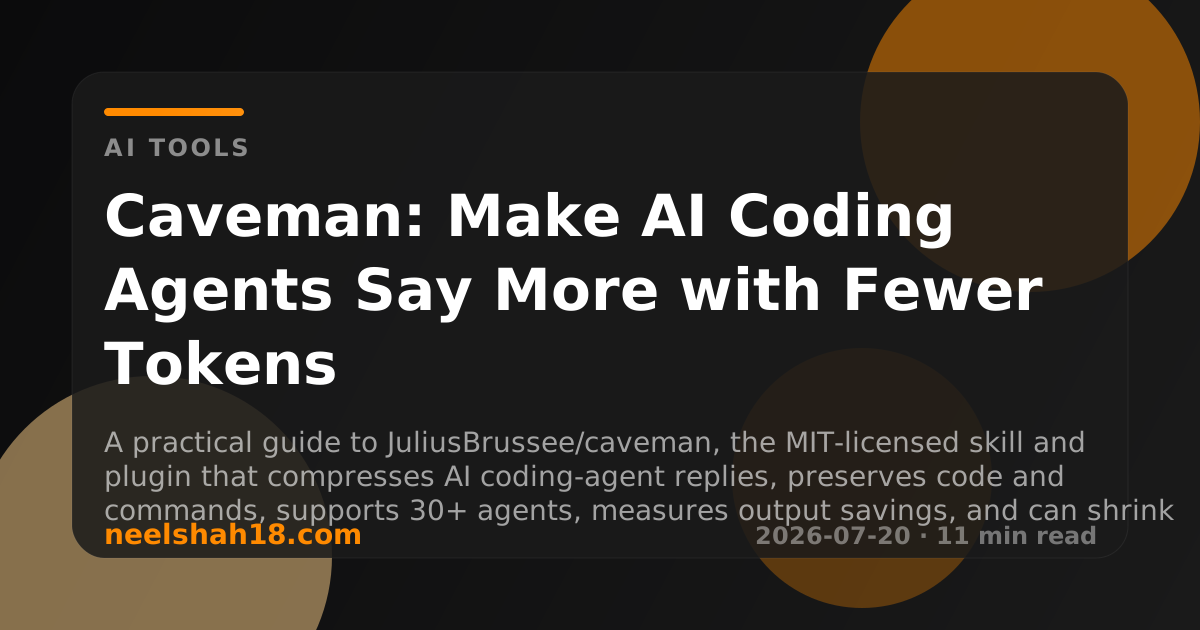
JuliusBrussee/caveman is an MIT-licensed skill and plugin that changes the agent’s speaking style: short fragments, less filler, same technical payload. It supports Claude Code, Codex, Gemini CLI, Cursor, Windsurf, Cline, Copilot, and more than 30 agent environments through plugins, extensions, rules, or skill registries.
The joke is “brain still big, mouth small.” That is also the correct architecture. Caveman does not compress the model’s internal reasoning or the input context. It constrains the final response and instructs the agent to preserve code, commands, paths, URLs, and errors exactly.
useMemo. New ref created every render.useMemo.useMemo it.What Caveman Actually Changes
Caveman installs a prompt-based skill or equivalent rule into supported coding agents. The instruction layer asks the model to:
- lead with the answer instead of conversational preamble
- use fragments where grammar adds no meaning
- avoid repeating the problem or conclusion
- preserve code, commands, errors, URLs, and paths
- keep the user’s language rather than translating it
- vary compression through
lite,full,ultra, andwenyanmodes
The repository also includes normal behavior and an additional mode in its six-level interface. wenyan deliberately uses classical Chinese for unusually dense expression; the other modes keep the language in which the user writes.
This is response-style control, not semantic compression inside the model. The agent still receives the same context and performs its normal work. The optimization is applied to what the user sees.
Install Once, Adapt to Each Agent
The cross-platform installer detects supported tools and places the right integration for each one:
curl -fsSL https://raw.githubusercontent.com/JuliusBrussee/caveman/main/install.sh | bash
Windows uses the PowerShell installer. Node.js 18 or newer is required, and the script supports targeted installs, dry runs, reruns, and uninstall flows documented in INSTALL.md.
Integration differs by product. Claude Code uses a plugin and hook, Gemini CLI uses an extension, while Codex, Cursor, Windsurf, and other tools can use skill registries or local rule files. This matters operationally: teams should inspect what is installed, where configuration is written, and how updates are distributed before running any remote installer broadly.
Commands Beyond Short Replies
Caveman is packaged as more than one style toggle:
/caveman [level]changes compression for the current session/caveman-commitcreates compact Conventional Commit messages/caveman-reviewformats terse, line-oriented review findings/caveman-statsestimates session and lifetime token savings/caveman-compress <file>rewrites persistent instruction or memory filescaveman-shrinkcompresses MCP tool descriptions as middlewarecavecrew-*provides concise investigator, builder, and reviewer subagents
The memory-file feature targets input tokens rather than output. A shorter CLAUDE.md or project note is loaded again in future sessions, so careful compression can compound. The risk is also persistent: remove a constraint once and every later session may lose it. Review diffs and keep the original under version control.
Reading the 65% Claim Correctly
The project reports an average 65% output-token reduction across ten prompts using Claude API token counts. The published range is 22–87%, with an average decline from 1,214 to 294 output tokens.
That number does not mean 65% lower total token usage or cost. The repository’s own “honest numbers” note makes three important qualifications:
- Input and reasoning tokens are not reduced by reply style.
- The skill adds roughly 1–1.5k input tokens per turn.
- Already-terse workloads can become net-negative.
Benchmark prompts, model versions, default verbosity, task mix, and scoring criteria all influence results. Reproduce the benchmark on your own agent and workload, then compare task correctness, review time, follow-up questions, total tokens, latency, and cost—not output length alone.
Brevity Can Lose Information
Concise answers are valuable when the audience already understands the domain and wants action. They are dangerous when uncertainty, tradeoffs, compliance reasoning, migration risk, or teaching context matters.
An agent can preserve every code byte and still omit an important warning in the surrounding prose. “Same answer” is therefore a quality target, not something guaranteed by word count. Useful evaluation questions include:
- Did the short reply preserve assumptions and uncertainty?
- Can a new team member act without asking for missing context?
- Were destructive steps and security implications still visible?
- Did tests, commands, and file references remain exact?
- Did fewer words create more follow-up turns?
Use lite for unfamiliar work, onboarding, or architecture decisions. Reserve ultra for repetitive tasks with shared context and easy verification.
Privacy and Security
According to the project, Caveman has no backend, accounts, analytics, or telemetry. After installation, the skill is local, hooks are local scripts, and stats read existing session logs. Network activity occurs during installation through GitHub and agent-specific registries.
Prompt skills still influence every response, so they belong in the software supply chain. Pin or review versions, inspect installer scripts, verify configuration changes, scope installation to intended agents, and test updates. A style instruction should not silently weaken higher-priority security, accuracy, or documentation requirements.
A Practical Adoption Workflow
Start with one agent and one week of representative tasks:
- Record baseline output, input, reasoning, latency, and follow-up turns.
- Enable
lite, then compare correctness and readability. - Try
fullon debugging, review, and implementation tasks. - Keep architecture, incident, legal, and security work less compressed.
- Review
/caveman-compresschanges before committing them. - Measure total session economics rather than headline output savings.
- Document a quick “normal mode” escape for the team.
The goal is not the fewest possible words. It is the smallest reply that preserves the information required for a correct next action.
Final Take
Caveman turns a meme into a useful interface experiment. AI coding agents do not always need to narrate their competence. A clear constraint can make routine work faster to scan, reduce output tokens, and leave more attention for code and decisions.
Its honest limitation is equally important: short output is only one part of the token budget, and brevity can hide context. Caveman works best as a configurable communication layer—measured against task success, not admired for small numbers alone.