
Voice AI has been stuck in an awkward place: the best user experience usually comes from closed hosted systems, while the most controllable systems often require research-code patience.
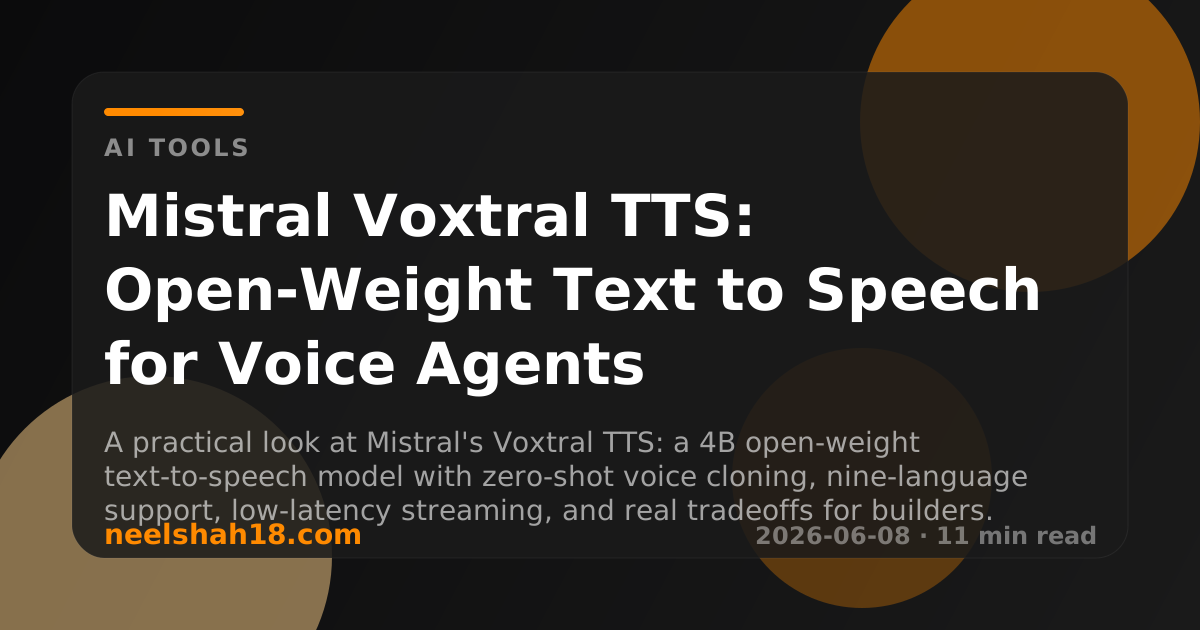
Mistral’s Voxtral TTS is important because it moves that boundary. It is a 4B text-to-speech model released as open weights under a CC BY-NC license, available through Mistral’s API and Studio, and designed for zero-shot voice cloning, multilingual generation, and low-latency streaming.
This is not just another “AI voice generator.” It is part of a larger shift: speech is becoming an application layer that developers can own, inspect, self-host for research, or wire into voice-agent workflows without treating every spoken sentence as a black-box vendor call.
What Voxtral TTS Is
Voxtral TTS is Mistral’s first dedicated text-to-speech model. The model card describes it as a state-of-the-art TTS system with zero-shot voice cloning, support for nine languages, streaming with roughly 90 ms time-to-first-audio at the model level, and no transcript requirement for voice prompts.
The announcement adds the product context: Voxtral TTS is lightweight at 4B parameters, available through the Mistral API at $0.016 per 1,000 characters, testable in Mistral Studio and Le Chat, and published as open weights on Hugging Face under CC BY-NC 4.0.
That combination matters. Hosted voice APIs are useful, but they create dependency, pricing, and governance constraints. Open weights create a different path for researchers, internal tool builders, accessibility experiments, and teams that want more control over the voice layer.
The Practical Feature Set
The user-facing features are straightforward:
- Zero-shot voice cloning from a short reference clip
- Voice-as-instruction, where rhythm, intonation, accent, and emotion come from the prompt audio rather than manual tags
- Multilingual generation across English, French, Spanish, Portuguese, Italian, Dutch, German, Hindi, and Arabic
- Cross-lingual voice adaptation, such as using a French voice prompt to produce English speech with a natural French-accented character
- Streaming inference for voice agents, assistants, dubbing systems, and interactive applications
The “voice-as-instruction” framing is especially useful. Many TTS systems ask developers to control prosody through explicit labels or brittle prompt conventions. Voxtral’s pitch is different: use a real voice sample as the control surface. That is more natural for creators and more direct for product teams building branded voices.
Architecture: Why It Is Not Just a Bigger TTS Model
The research paper describes Voxtral TTS as a hybrid system. A transformer decoder predicts semantic speech tokens autoregressively, while a flow-matching acoustic transformer generates the richer acoustic detail. Those tokens are produced by Voxtral Codec, an audio tokenizer trained from scratch.
In plain engineering terms, the model separates two jobs:
- Keep the utterance coherent over time.
- Render the acoustic texture that makes the speech sound like a person.
That split is important because speech is not only text with sound attached. Timing, accent, breath, pauses, disfluencies, energy, and speaker similarity all matter. A model can be intelligible and still feel wrong. Voxtral’s architecture is built around the idea that semantic consistency and acoustic realism need different machinery.
Quality Claims Worth Reading Carefully
Mistral reports that Voxtral TTS was preferred over ElevenLabs Flash v2.5 in human evaluations, with a 68.4% win rate in multilingual zero-shot voice cloning. The paper also reports language-specific win rates, including 60.8% for English, 54.4% for French, 72.9% for Arabic, 79.8% for Hindi, and 87.8% for Spanish.
Those numbers are useful, but they should not be read as “Voxtral wins every possible production scenario.” Human voice preference depends on language, use case, reference audio quality, deployment stack, and what the listener values: similarity, naturalness, emotional control, latency, stability, or editability.
The more practical conclusion is narrower and stronger: open-weight TTS is now close enough that teams should include it in vendor evaluations instead of assuming hosted proprietary systems are the only serious option.
Why Open Weights Change the Decision
Open weights do not automatically make a model free for commercial use. Voxtral TTS weights are released under CC BY-NC, so teams need to read the license before building a commercial product around self-hosted weights.
Still, open weights are meaningful:
- Researchers can inspect and evaluate the model more directly.
- Internal teams can prototype local speech workflows.
- Builders can test latency, language coverage, and voice adaptation outside a fully closed platform.
- The community can compare, critique, and improve deployment patterns.
For enterprise teams, the API may still be the practical path. For labs, startups, and local-AI builders, the weights make Voxtral more than a hosted feature announcement.
Where It Fits in a Voice Stack
Voxtral TTS is the output layer. It turns text into speech. A full voice agent still needs other pieces:
- Speech-to-text for incoming audio
- A conversation or task model
- Tool calling or workflow execution
- Conversation state and memory
- Safety, consent, and abuse controls
- Observability for latency, failures, and user experience
Mistral explicitly positions Voxtral TTS alongside Voxtral Transcribe for speech-to-speech systems. That is the right mental model: TTS is not isolated anymore. It is part of a loop where audio goes in, reasoning happens, and speech comes back out.
What Builders Should Test First
If you are evaluating Voxtral TTS, do not start with a perfect demo sentence. Start with your actual product constraints.
Test short and long responses. Test noisy reference clips. Test same-language and cross-language voice prompts. Test domain vocabulary. Test interruptions. Test whether users tolerate the time-to-first-audio in your real UI. Test whether the voice remains consistent after several generations.
For bilingual or multilingual products, test accent intentionally. Cross-lingual voice adaptation can be a strength, but sometimes the right output is not “same voice, preserved accent.” Sometimes the right output is local fluency. That is a product decision, not only a model metric.
The Governance Problem Does Not Disappear
Voice cloning has obvious misuse risk. Local or open-weight access increases control for legitimate users, but it also increases responsibility. Product teams should design around consent, disclosure, watermarking or provenance where appropriate, access controls, rate limits, and clear policies for cloning real people.
The serious use cases are valuable: accessibility, localization, education, support agents, internal training, creator workflows, and multilingual product experiences. Those use cases get stronger when users can own more of the pipeline. But the same capability can be abused if consent and identity are treated casually.
The Bigger Signal
Voxtral TTS is a sign that speech generation is entering the same phase text models entered earlier: closed APIs are still strong, but open-weight systems are becoming good enough to change architecture decisions.
That does not mean every company should self-host TTS tomorrow. It means the default architecture conversation changes. Instead of asking “Which hosted voice API do we buy?”, teams can ask:
- Do we need hosted reliability or local control?
- Is the license compatible with the use case?
- How sensitive is the audio?
- How much latency can the interface tolerate?
- Which languages and accents matter?
- Can we measure real listener preference in our own workflow?
For voice agents, the answer will often be hybrid. Use a managed API when reliability and support matter most. Use open weights when research, privacy, cost control, customization, or product sovereignty matter more.
That is why Voxtral TTS is worth watching. It gives builders a credible open-weight option for the voice layer, and it makes speech feel less like a locked feature and more like a system component.