
Banks are not usually the first place developers look for open-source AI tooling.
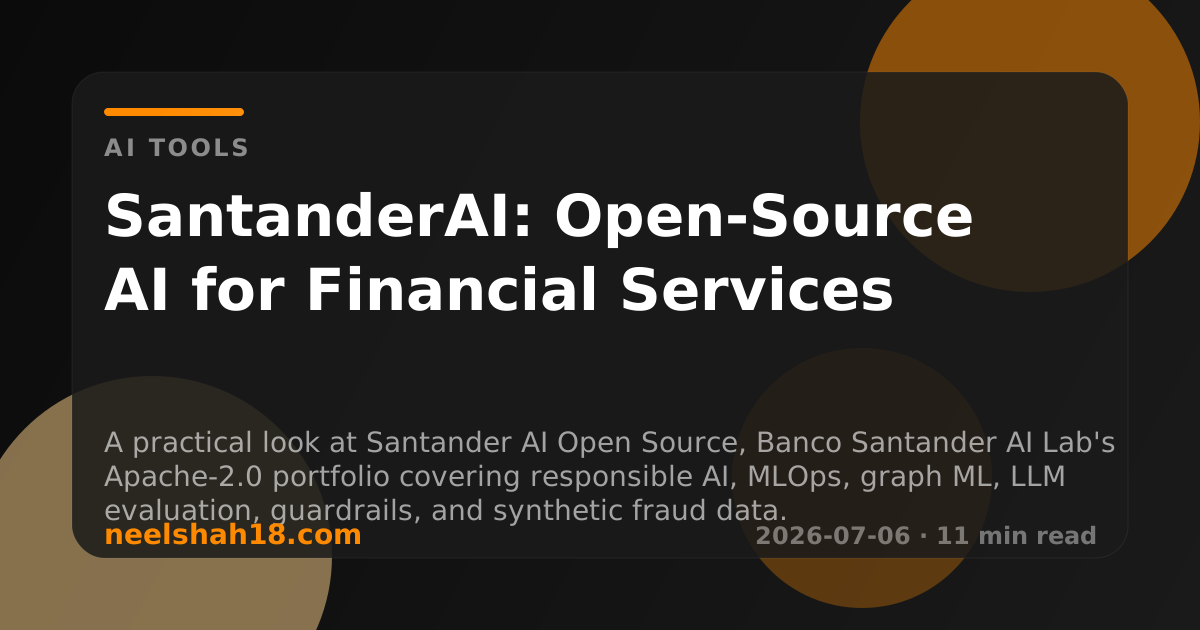
That is what makes SantanderAI worth studying. Banco Santander AI Lab has published a public GitHub organization for artificial intelligence projects built around financial-services problems: responsible AI, MLOps, graph machine learning, LLM evaluation, guardrails, synthetic fraud graphs, embedding adapters, causal fairness research, and agent engineering.
The interesting part is not only that the repositories exist. It is the shape of the portfolio. Instead of one demo model, SantanderAI looks like an attempt to open source the practical layers around AI in a regulated environment: data safety, governance, robustness, decision oversight, evaluation, and reusable developer tools.
For builders working in banking, insurance, healthcare, government, or any domain where AI systems need traceability, this is more useful than another benchmark headline. It shows how an enterprise AI lab can contribute tools without publishing customer data or internal business logic.
What SantanderAI Is
SantanderAI is the public open-source home for Banco Santander AI Lab. The organization describes its mission as building AI tools for small models, harness engineering, evolving agents, responsible AI, MLOps, and graph machine learning for financial services.
The repositories are intentionally broad. Some are research code. Some are developer utilities. Some are synthetic data generators. Some are governance scaffolds for LLM systems. The common thread is practical AI in a regulated setting.
The organization also makes an important data-safety claim: projects use synthetic or anonymized data only, and no real customer information is published. That sentence matters. In financial services, open source is not just a licensing decision. It is a privacy, legal, security, and model-risk decision.
The Projects That Stand Out
The most visible repository is gen-fraud-graph, a synthetic fraud graph generator for training and benchmarking graph-based fraud detection models. It is designed to scale to more than 100 million accounts. This is exactly the kind of project that is useful to the broader community because real fraud networks are sensitive and hard to share.
llm_bridge solves a different problem: a small, vendor-neutral LLM client interface with adapters for OpenAI, AWS Bedrock, Google Gemini, and custom backends. For enterprise teams, that kind of abstraction is not cosmetic. It reduces lock-in and makes evaluation across providers easier.
mech-gov-framework is more directly about high-stakes decision systems. It focuses on model-agnostic governance regimes, hard gates, and governance metrics for LLM decisions. This is the layer many AI demos skip: what happens after a model produces an answer, and how does an organization decide whether the answer can be used?
autoguardrails is an alignment-research scaffold for guardrails over a single policy.md surface. The idea is useful because many guardrail systems become scattered across prompts, validators, tests, and application code. A single policy surface makes experimentation and review easier.
There are also research and evaluation repositories: causal-perception-implementation for causal models applied to fair credit decisions, mutatis-mutandis for discrimination analysis with counterfactual comparators, and sota-stressed-datasets for robustness testing through stressed benchmark datasets.
On the agent side, ralph is a configurable Bash and PowerShell loop that runs an AI coding CLI with a fresh session each iteration. ralph-vault-skill complements that by generating a knowledge vault for projects using the loop. These are not banking-specific tools, but they reflect a very practical question: how do you make AI-assisted engineering repeatable enough for serious work?
Why This Matters for Regulated AI
Most AI tooling is optimized for speed. Regulated AI needs speed, but it also needs auditability, policy control, data separation, explainability, and failure handling.
That is why the SantanderAI portfolio is interesting. It covers several weak spots in enterprise AI adoption:
- Synthetic data: useful examples and benchmarks without releasing sensitive records.
- Graph ML: fraud, account, device, and relationship patterns are naturally graph-shaped.
- Governance: high-stakes model outputs need gates, metrics, and reviewable policies.
- Robustness: datasets need stress testing, not only clean benchmark scores.
- Provider portability: LLM applications need room to compare vendors and switch backends.
- Agent operations: AI coding and research loops need repeatability, not just clever prompts.
This is the difference between “we used an LLM” and “we can operate an AI system responsibly.”
The Open-Source Governance Signal
SantanderAI also publishes an open-source governance model. The organization describes a two-track review process. Fast Track covers forks, generic tools, tutorials, datasets, and SDKs without business logic. Full Track covers AI models, frameworks with IP, or code that touched internal data, with review by an open-source program office, legal, security, and architecture stakeholders.
That detail is valuable because it shows how a large financial institution can make open source a normal engineering path instead of an exception.
The Apache-2.0 licensing pattern also matters. It is permissive enough for broad adoption while still giving clear legal terms to companies that may want to study, adapt, or integrate the tools.
Where Builders Can Use It
SantanderAI is most relevant if you work on AI systems where mistakes are expensive or regulated:
- fraud detection and graph analytics
- responsible AI and fairness testing
- LLM evaluation and governance
- retrieval systems with embedding adaptation
- AI coding loops and internal agent workflows
- synthetic data generation for benchmarks
- banking, insurance, healthcare, government, and compliance-heavy software
The projects are not a finished AI platform. They are a set of reusable pieces. That is often better. Teams can inspect one repository, adapt one technique, or reuse one evaluation pattern without adopting a full stack.
My Take
SantanderAI is important because it points to a healthier enterprise open-source pattern.
Instead of publishing a polished marketing demo, the AI Lab is releasing pieces that sit around the model: governance frameworks, synthetic datasets, robustness tests, graph generators, adapters, and agent workflows. Those are the parts that determine whether AI survives contact with production constraints.
For financial services, the message is clear: open-source AI does not have to mean exposing sensitive data or abandoning controls. It can mean publishing reusable infrastructure, research scaffolds, and evaluation assets that help the broader community build more trustworthy systems.
For developers, SantanderAI is worth bookmarking less as a single tool and more as a map of the problems serious AI teams are actually solving.